Hospital Readmission

Definition & why we measure

The Hospital Readmission Percentage is defined as the percentage of patients discharged from the hospital (inpatient) who are readmitted to the hospital within 30 days of discharge1. This measure evaluates the quality of care given during the admission period and the coordination of care after discharge. The measure does not include planned readmissions. Unplanned readmission would indicate ineffective care, premature discharge, inadequate patient education, inadequate adherence to treatment after discharge. In this measure, the lower the number the better the performance.

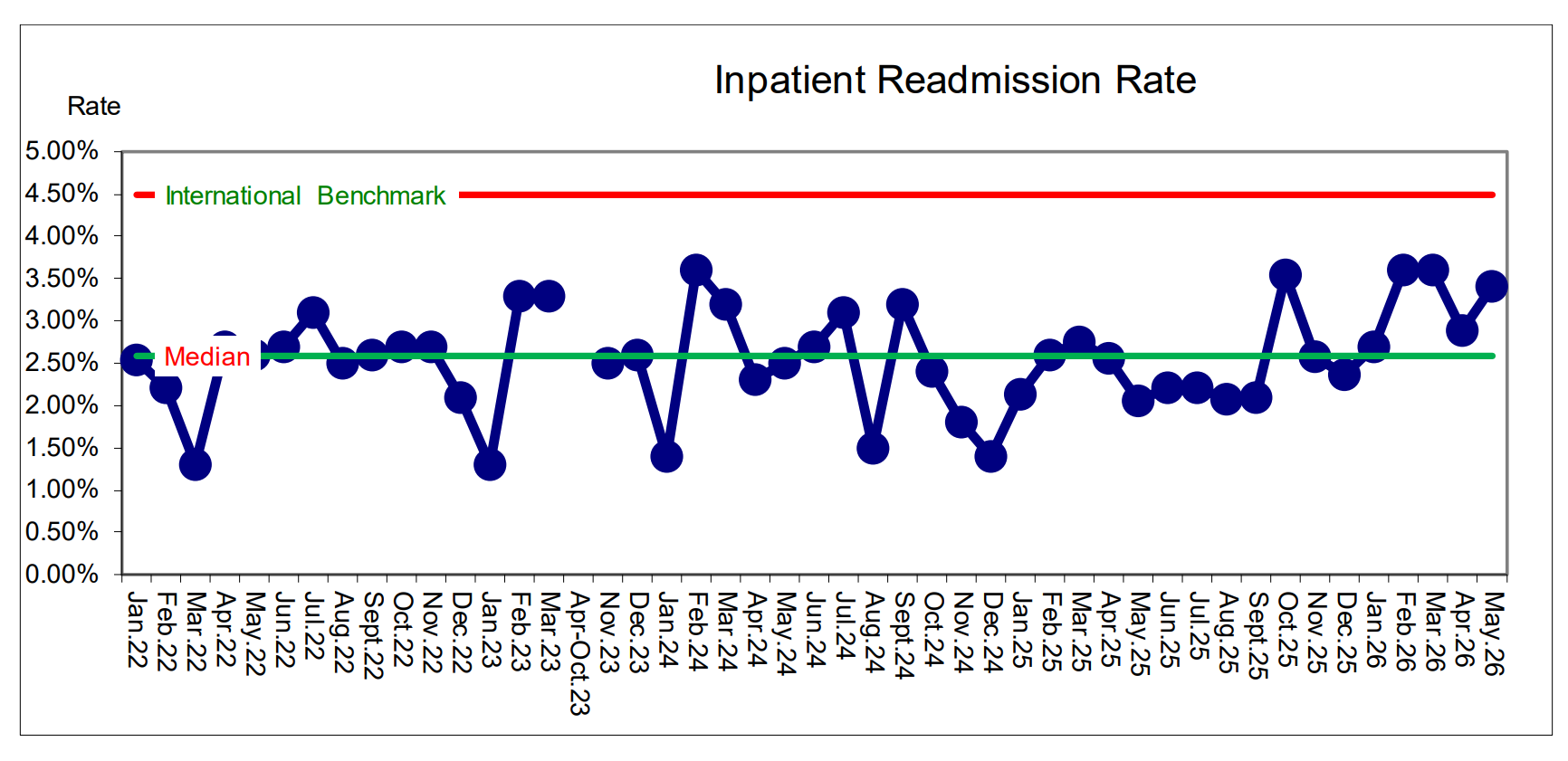
Against a benchmark of 4.49, Gertrude’s children’s hospital has performed consistently well over the years as per graph below.2 Our readmission percentage have averaged 2.21% in past one year.

What are we doing to improve?

We have established standard practice guidelines and clinical pathways to standardize medical care. This is supported with multidisciplinary ward rounds, and ongoing review of the care provided. We also provide patient and family education regarding the illness they are being treated for and improved the care coordination and communication with patients/families to improve adherence to treatment after discharge.

Note: the lower the number the better the performance.

Reference:

  1. Bice T. ICU Readmissions: Good for Reflection on Performance but Not a Reflection of Quality. Crit Care Med. 2016 Sep;44(9):1790-1. doi: 10.1097/CCM.0000000000001809. PMID: 27526001; PMCID: PMC4988323
  2. Martin L, Nelson E, Rakover J, Chase A. Whole System Measures 2.0: A Compass for Health System Leaders. IHI White Paper. Cambridge, Massachusetts: Institute for Healthcare Improvement; 2016. (Available at ihi.org)
Book Appointment